Cartesian coordinate system
The Cartesian coordinate system explained simply: X, Y and Z axes, origin and coordinates as the foundation of every position in an NC program.
The Cartesian coordinate system, named after the French mathematician René Descartes, is used to describe points in a plane or in space unambiguously. In CNC technology it is the foundation of every position: each point the tool moves to is defined by coordinates.
Two dimensions: X and Y
In the two-dimensional coordinate system, two axes are perpendicular to each other: the X-axis runs horizontally, the Y-axis vertically. The point where the two axes intersect is called the origin and carries the coordinate pair (0, 0).
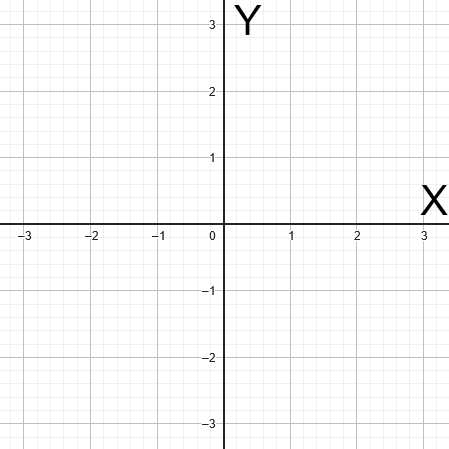
A point is defined by its X and Y coordinates: the X coordinate gives its horizontal position relative to the origin, the Y coordinate its vertical position. Positive X values lie to the right of the origin, negative ones to the left; positive Y values lie above, negative ones below.
Points are usually written in the form (x, y). The point (2, 3) therefore lies two units to the right of and three units above the origin.
The third dimension: Z
The three-dimensional Cartesian coordinate system extends the two-dimensional one by an additional axis, the Z-axis. It is perpendicular to the XY plane and makes it possible to describe points in space. The Z coordinate gives the position along the Z-axis.
From model to machine
This exact system is found on every CNC machine: on a 3-axis milling machine, the X- and Y-axes move the tool in the plane of the machine table, while the Z-axis runs along the spindle and determines the cutting depth. Every position in an NC program, for example X10 Y20 Z-5, is therefore nothing more than a point in this coordinate system.